I'll start off with a confession: I built AudioPen by accident.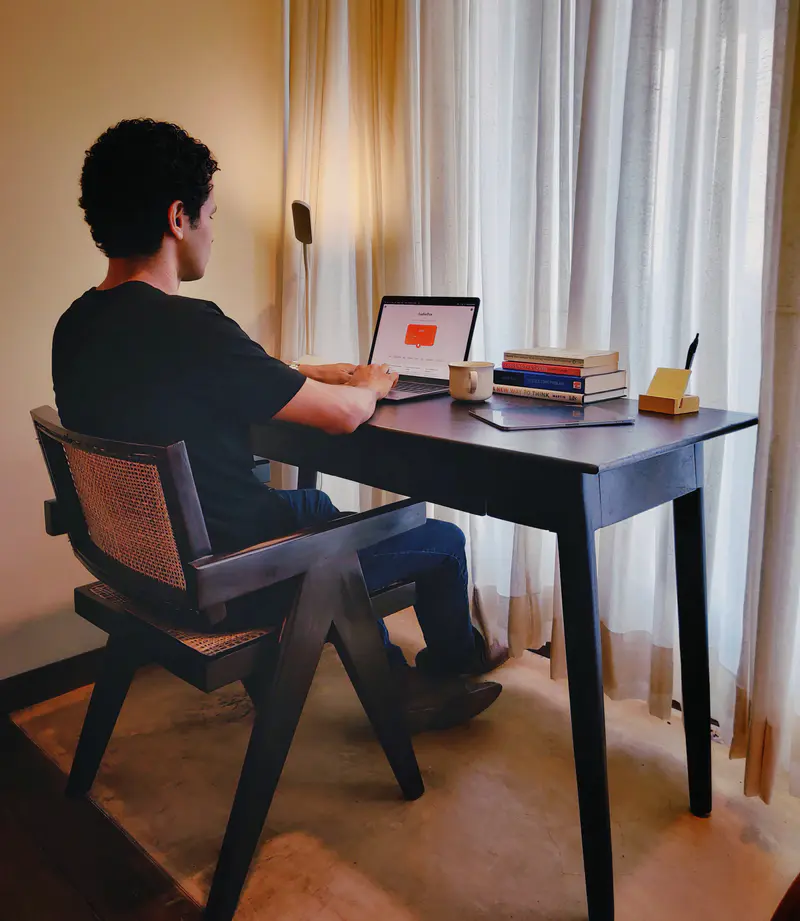
I'm Louis and I live in Goa, India.
I'm what they call an indie-hacker. In fact, I'm not even that. I'm a part-time indie-hacker.
During the day, I work with my family business in the offline world. At night, I build assets on the internet. I've dabbled with building things online for years, ever since 2015. But I've never been able to code. I've always tried and given up half way.
From 2015 till 2020, all I had were ideas to build things on the internet, but I lacked the skills to bring them to life.
Luckily for me, in early 2021, technology caught up with my imagination.
Discovering Bubble
Like most people during the pandemic, I spent quite a lot of time and money on online courses to learn new things. One of those things was Bubble.io. And boy did it pay off.
Bubble may feel antiquated today in 2026. But back in 2021, it was at the bleeding edge of no-code development. For the first time in over half a decade, I had found a tool that molded itself to my ideas, instead of me having to mold my ideas to fit the limitations of all the tools I had tried. And I absolutely loved it.
I started experimenting with Bubble, and I built multiple tools just for fun. I'd stay up at night, and just build. Most tools went nowhere. Some of them made it all the way to launch. But most of the ones I launched, failed. A couple, like Read Something Great and Nicheless survived.
For the first time in my life, I didn't feel the need to learn how to code. I felt like my ideas had wings. All I had to do was keep building, and I hoped to finally stumble upon an idea that would find mass appeal.
Half Day Build Hackathon

A few months after discovering my love for building with Bubble, I decided to start a hackathon. I called it HalfDayBuild and even bought the halfdaybuild.com domain (which I then forgot to auto-renew, but I'll save that story for another day). The idea was simple: invite a bunch of friends from Twitter, and each of us would try to turn an idea into revenue within 12 hours on a specific day. All while live tweeting about our progress.
In the initial hackathons, about 30 people joined. But as the months went by, the numbers grew to over 100 participants. People built all sorts of stuff—online courses, SaaS products, even robots they sold online. Simple robots, but robots nonetheless. It was wild to watch.
Starting HalfDayBuild is one of the things I'm most proud of myself for. I know it encouraged people to get started in the internet economy, and I'm grateful that I could be a part of their journeys.
Besides organizing each HalfDayBuild, I built a bunch of stuff during each hackathon too! Unsurprisingly, most failed. They never made any revenue. Some that did, barely made any. But I had a blast. I would build stuff for free all day if I could, but unfortunately for the world, I also have bills to pay.
My happy accident: Stumbling upon AudioPen
In early 2023, OpenAI's APIs were becoming very popular. GPT-3 was the latest at that point, and folks on Twitter were buzzing about it. I hadn't experimented with any AI tools yet, but I wanted to.
However, I had so many failed products languishing on domains and servers that I was paying for every month, that the thought of starting something new seemed like a bad idea. I feared I'd tumble down a rabbit hole, building more products that would only create bills to pay, without generating any revenue.
So that week, I decided to try something different. I decided to build a bunch of tools and host them on my own website. Here's a screenshot of that site, which still survives.
In under a week, I had built five tools, each one doing something completely unrelated to the others. I was building just to learn, just for fun. As I finished each tool, I shared it on Twitter. I didn't expect anything to come from this. I was still early in my experimentation with AI. However, I was wrong.
As I released each tool, people commented, liked, and sometimes retweeted. But when I released AudioPen (which was a rudimentary version of the current tool), it got a lot more love than I expected.
Loads of people commented, saying they could imagine using AudioPen in ways I hadn't even thought of. That made me pay attention.
HalfDayBuild X AudioPen
The next HalfDayBuild was under a week away. I still hadn't found an idea to build, so I thought, why not just go for a full version of AudioPen? I wasn't the target user then, and I didn't fully grasp what people liked about it. But there was something there worth exploring.
No other tools were similar because it was early days for AI. I figured, what's the worst that could happen? If nobody likes it, it's fine. I'm used to that already. At least here, my chances of success felt higher than with any other idea I had.
So I said, screw it. Let's build.
In the days leading up to the HalfDayBuild, I sat down in Figma and designed a bunch of screens for AudioPen. Design usually takes me a while, so I figured I'd get it out of the way before HalfDayBuild. That way, I could focus purely on building during those 12 hours.
The day arrived, and I knew exactly what I wanted to build. I'd already shared some screenshots on Twitter. So, I dove straight into building and live-tweeting about it.
In under 12 hours, the site was live. A few test users from Twitter trickled in, and I even got my first paying customers. Since that day in March 2023, I've been chipping away at making AudioPen better.
This year, I plan to keep at it.
I'm still a part time indie-hacker. And I'm still having the time of my life building this thing. I hope you'll give it a try.