






How to do a brain dump and turn it into a plan
Get everything out of your head in five minutes, then give each task a next step. Why it works, a worked example, and how to do it out loud.
The short answer: a brain dump means getting everything out of your head without sorting it. Set a timer for five minutes and say or write every task, worry and idea. Then give each task a next step and a day. That second half is what keeps your head clear.
It's eleven at night, or the middle of a meeting, or the walk home. Your head is running a list nobody wrote down: the report, the reply you owe, the dentist, the thing your manager said. None of it is hard. There's just too much of it, all at once.
A brain dump gets that list out of your head. A plan keeps it out. And the first half goes better out loud than on a keyboard.
Why does a brain dump work?
Your brain doesn't file a thought and move on. It keeps pinging you about it until you do something with it. That's why the email you forgot to send keeps nagging at you, and the one you sent yesterday doesn't.
Psychologists have tested what makes the pinging stop. In a series of lab studies published in 2011, E. J. Masicampo and Roy Baumeister found that unfinished goals kept popping into people's heads while they tried to read, and got in the way of solving word puzzles. When people wrote a specific plan for each goal, those effects went away, even though the goals were still unfinished.
A 2018 study tested the same idea at bedtime. In a sleep lab, 57 adults aged 18 to 30 spent five minutes writing before lights out. Those who wrote a to-do list for the next few days fell asleep about nine minutes faster than those who wrote about what they had already done. The more specific the list, the faster they fell asleep.
Put the two side by side. Getting it all out is only the start. What quiets it is deciding what happens to each thing next, and the more specific, the better.
How do you do a brain dump?
- Pick a moment when your head is usually full: a morning walk, the end of the workday, right after a stressful meeting.
- Set a timer for five minutes. If you run dry sooner, stop there.
- Talk, don't list. Say what's on your mind in any order, half sentences and all. Don't sort anything yet.
- Read it back and mark every task in it.
- Give each task one next step and a day.
Is it better to talk or write a brain dump?
A retired business mentor I know wakes up at 3 a.m. with ideas. He used to scribble them on paper but couldn't read his own handwriting in the morning. Now he speaks into his phone for two minutes and goes back to sleep. The idea is captured. His brain lets go.
Most people try to brain dump by typing. That's a mistake. The moment your fingers touch a keyboard, the editing reflex kicks in. You start a sentence, delete half of it, rewrite it, wonder if that's really the right word. You check your email. You come back. You've forgotten what you were saying.
Speaking doesn't have this problem. You can't unsay a sentence halfway through, so the filter stays off and the mess comes out fast, which is exactly the point.
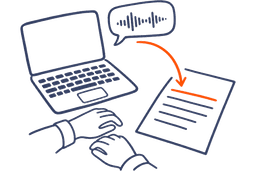
What you need is something messy on the way in and clean on the way out. A ten-minute recording is useless if you have to listen to all of it again. AudioPen gives you back a clear note instead, so you read it once and pull out what matters. The same trick works for email, which I wrote about in how to draft emails by talking.
How do you turn a brain dump into a plan?
This is the half most brain dump advice skips.
- Sort it into three piles. Tasks you can do something about, ideas worth keeping, and worries.
- Give every task one next step. Not "website," but "send Priya the new homepage text." If you could start it in the next five minutes, it's specific enough.
- Give it a day. Today, this week, or a date to look again. "Not now" is a fine answer, as long as it has a date.
- Break the big ones down. If you can't see the first step, the task is really a project. Write down only the first step for now.
- Keep today short. Pick the two or three things that matter today and move the rest to later in the week.
- Keep ideas somewhere you'll see them again. A note you read once a week is enough. A worry you can act on becomes a task. One you can't act on belongs in a feelings dump.
What does a brain dump look like?
Here's thirty seconds of a spoken brain dump, the way it really comes out:
Okay so, the client report is due tomorrow and I haven't started the numbers section, and I owe Sam a reply about the venue, I keep forgetting that. Also the dentist, I need to book that. And next week's posts, I haven't planned anything. Oh, and I want to redo the website at some point, and there was that idea about a newsletter. Honestly I'm mostly stressed about the report.
And here's the plan it turns into:
| What you said | Next step | When |
|---|---|---|
| Client report | Next step:Write the numbers section first | When:Today, before lunch |
| Reply to Sam | Next step:Send the venue decision | When:Today |
| Dentist | Next step:Call and book a check-up | When:Tomorrow morning |
| Next week's posts | Next step:List three post ideas | When:Thursday |
| Redo the website | Next step:Not now | When:Look again on the 1st |
| Newsletter idea | Next step:Save it in the ideas note | When:Sunday review |
The stress about the report didn't get a row. Once the report had a first step and a time, you could stop carrying it around tonight.
Is a brain dump for tasks or for feelings?
Here's what the productivity crowd misses: brain dumps aren't only for tasks. They're for feelings too. They're two different dumps, and they end in two different places.
A linguistics professor with ADHD told me that dumping his email backlog into AudioPen, before sending a single reply, was worth the price on its own. The emails hadn't changed. But they were out of his head and into text, and that made them manageable. If your head works like his, here's how people with ADHD use AudioPen for brain dumps.
A retired meditation teacher near Chicago does the other kind. Fifteen minutes of spoken reflection every morning, which he calls "inquiry." He's not trying to be productive. He's trying to understand what he's feeling. The note he gets back is a mirror, not a to-do list.
Both kinds show up in AudioPen's own numbers. In a sample of 20,000 AudioPen notes from July 1 to September 28, 2026, the two most used writing styles after Clear & Simple (29.6%) were List, on 6.1% of notes, and Journaling, on 5.3%.
So decide which dump you're doing before you start. A task dump wants the plan above. A feelings dump doesn't need one: you talk until the pressure drops, and the note you get back is proof that the noise in your head had real content. It wasn't just static.
How do you brain dump with AudioPen?
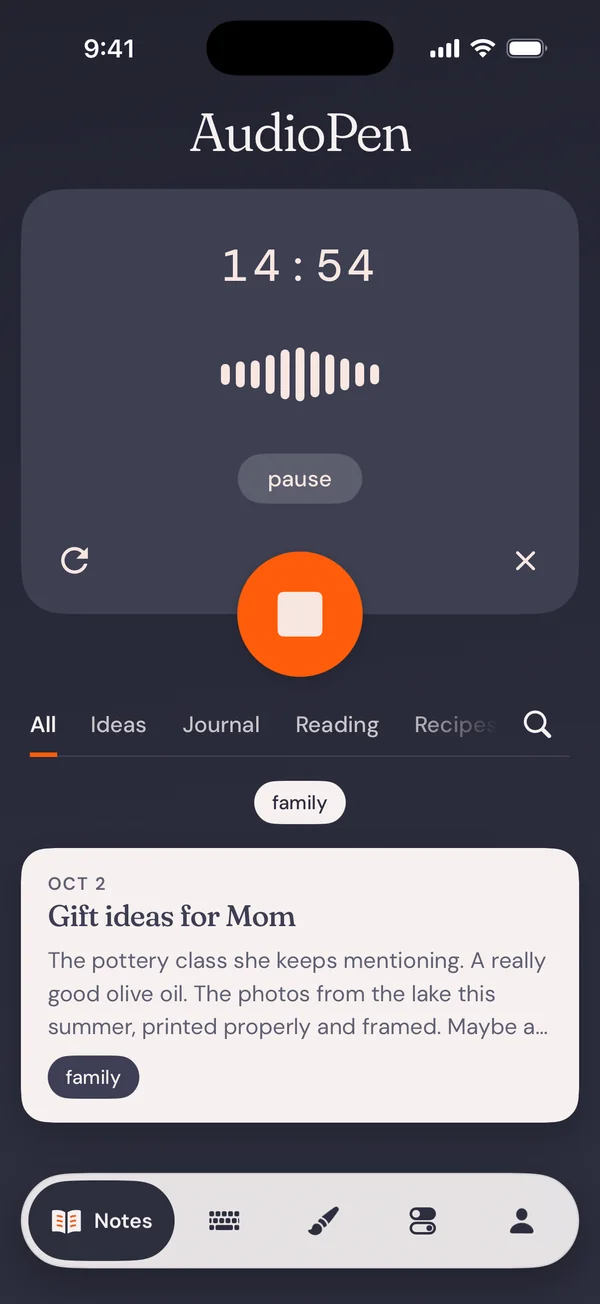
- Open AudioPen on your phone, your computer or the web. On a walk, you can start a recording from your Apple Watch.
- Pick a style before you talk: List for a task dump, Journaling for a feelings dump. On Prime, you can also restyle a note after it's saved.
- Tap record and talk. The free plan records up to 3 minutes at a time, and Prime up to 15. On the free plan, set your timer for three minutes, or make two short notes.
- Read the note AudioPen writes. You set how much it edits, from Low to High, so it can stay close to your words.
- Copy the tasks into Todoist, Apple Reminders or your calendar, and give each one its day.
You can also write your own style, such as a list sorted into today, this week and later. In the iPhone and Android apps and on Mac and Windows, you can turn on offline transcription in settings, so the recording never leaves your device.
How do you make a brain dump a habit?
A medical researcher I spoke to starts every morning the same way. She puts in her AirPods and talks to AudioPen for ten minutes while she walks. By the time she gets home, the three research ideas that were tangled together have separated. The grant deadline she kept forgetting is a line item. And the conversation with a colleague that had been gnawing at her turns out to be nothing.
Give it a trigger, so you don't have to remember to do it: the walk, the commute, closing your laptop at six.
Your head is full. Talk to AudioPen until it isn't.